Future Trends in Enterprise AI Solutions
Key Takeaways
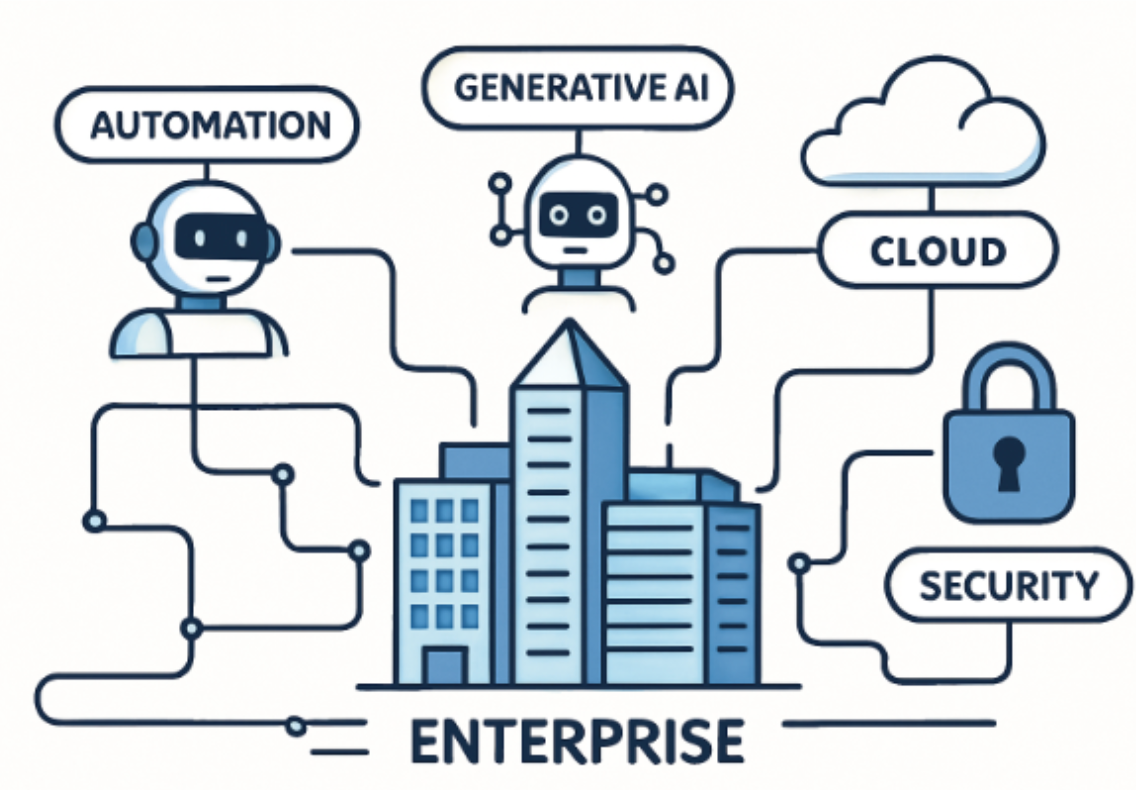
- Agentic AI is poised to transform automation by allowing systems to handle intricate tasks with little human supervision.
- Generative AI copilots are set to streamline business workflows, providing crucial support to professionals in day-to-day operations.
- Industry-specific cloud platforms will offer enterprise solutions tailored to unique regulatory and operational demands.
- Quantum computing is on the verge of breaking complex barriers that traditional computing cannot address, opening new possibilities for businesses.
- Zero-trust security models will be fundamental in protecting enterprise data against rapidly evolving cybersecurity threats.
Artificial Intelligence (AI) is reshaping how businesses operate, with emerging trends that promise to significantly enhance efficiency, accuracy, and customer engagement. Organizations are investing in AI-powered tools and platforms to automate processes, generate insights, and create enhanced customer experiences. Enterprise solutions built on AI are no longer just about improving performance but about driving innovation and maintaining a competitive edge. To stay ahead, enterprises must understand the evolving landscape of AI technologies and their far-reaching implications. For those looking to guide their organization, exploring the best enterprise AI solutions can provide essential knowledge and a strategic advantage.
One of the most transformative shifts in business technology today is the movement towards more autonomous, intelligent systems. From agentic AI frameworks capable of making independent decisions to quantum computing, unlocking new problem-solving capabilities, AI is drastically broadening what enterprises can achieve. At the same time, companies face increasing pressure to uphold robust cybersecurity and sustainable practices in the design and implementation of these solutions.
The drive for cloud platforms tailored to specific industries continues to advance, with growing reliance on digital twins and adoption of XR (Extended Reality) for immersive applications. As AI capabilities grow, organizations must pivot quickly to ensure technology strategies align with evolving regulations, security requirements, and environmental goals.
Agentic AI: The Next Frontier in Automation
Agentic AI systems are designed to reason, plan, and execute tasks independently, with the intelligence to adapt to changing scenarios without constant human input. They represent the next evolution in automation, capable not only of following instructions but also of making complex decisions in real time. This advancement is a game-changer for industries such as cybersecurity, where agentic AI can autonomously detect threats and respond faster than traditional systems. The adoption of agentic AI, however, also requires robust governance mechanisms to address risks associated with system autonomy. For a deeper look at agentic AI’s role in business security, see TechRadar’s analysis.
Generative AI Copilots: Augmenting Human Capabilities
Generative AI copilots are enabling professionals to automate and enhance day-to-day tasks, such as drafting emails, writing code, and generating analytical reports. In sectors like law, healthcare, and manufacturing, AI copilots streamline complex workflows, improve accuracy, and free up human resources for more critical thinking and creative roles. According to recent forecasts, by 2026, about 80% of enterprise applications will feature embedded AI copilots. This development highlights a significant shift towards collaborative intelligence, where AI systems provide proactive support and recommendations to human users.
Industry-Specific Cloud Platforms: Tailored Solutions
The rise of industry-specific cloud platforms provides enterprises with software, data models, and infrastructure tailored to sector-specific needs and compliance requirements. These platforms accelerate deployment and ensure regulatory alignment, particularly in fields like healthcare and finance. Adoption is rapidly increasing, with market research estimating that 70% of enterprises will use these targeted cloud solutions by 2026, up from just 15% in 2023. This shift marks a strategic movement from generic tools towards highly specialized environments that promote efficiency and operational compliance.
Quantum Computing: Unlocking New Possibilities
Quantum computing promises to perform highly complex calculations at speeds beyond the reach of classical computers. For industries like logistics, pharmaceuticals, and finance, quantum capabilities will offer unprecedented opportunities for drug discovery, supply chain optimization, and high-frequency trading. However, as these quantum systems become more accessible, companies will need to adapt by deploying quantum-safe encryption to protect sensitive data against quantum-enabled cyber threats.
Zero-Trust Security Models: Ensuring Data Integrity
Enterprises are moving away from perimeter-based security toward zero-trust models, where identities and access rights are continually verified. With more devices and users connecting remotely, this model is vital for minimizing risk and securing data across diverse platforms. By 2026, enterprises will focus on the uniform administration of security policies, the safeguarding of assets, and real-time compliance. The trend is clear: consistent and adaptive security must be at the core of digital transformation efforts.
Extended Reality (XR): Immersive Enterprise Applications
Extended Reality is entering the enterprise mainstream, offering virtual and augmented environments for training, remote assistance, and immersive collaboration. As XR technology matures, businesses gain new capabilities for employee training, operational efficiency, and customer engagement. Market projections anticipate the XR industry could reach $380 billion by 2036, as companies realize the productivity benefits of immersive, hands-on experiences.
Sustainable Technology: Integrating Green Practices
Sustainability is now integral to enterprise technology strategies, not only for regulatory compliance but also as a driver of operational efficiency. Businesses are leveraging green software engineering techniques and using AI to track, measure, and reduce energy consumption. The “green by design” approach ensures that future enterprise solutions consider their environmental impact from the outset, aligning business goals with ecological responsibility.
Digital Twins: Simulating Success
Digital twins have evolved far beyond single-system simulations. Modern digital twins integrate data from multiple sources, allowing businesses to model entire processes, organizations, or environments. This predictive capability leads to faster product development, more efficient workflows, and better risk management. By 2026, digital twins will become a vital tool for enterprise decision-makers, enabling them to simulate and refine strategies before implementation in the real world.
The rapid shift towards advanced enterprise AI solutions presents both opportunities and challenges. By adopting these emerging trends, businesses will be better positioned to innovate, protect their assets, and achieve sustainable growth in a digital-first economy.